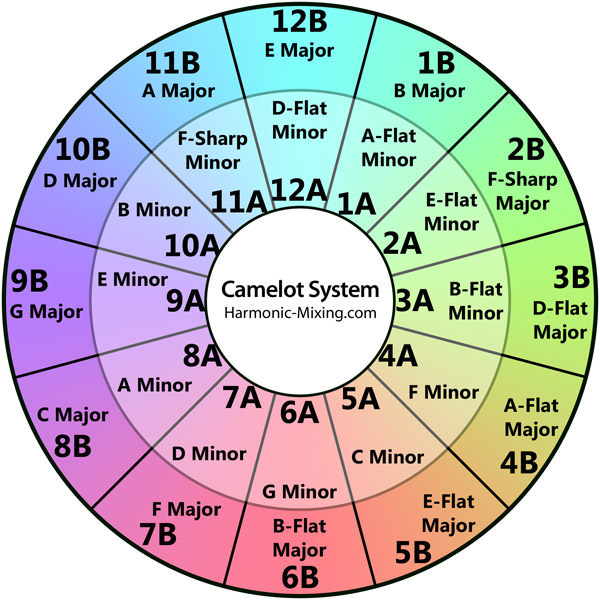
See, the purpose of this thread wasn't just bout finding the right notes inside your beat but how to make your beat fit within a live set of many other beats.
Fair call to everyone who uses their ears to find what sounds right. We've all been subconsciously trained to hear
right from
wrong notes by listening to conventionally composed music. My point was how to make a live set on a sampler or two flow like a DJ's set. Complete with blends & all that shit they do. By matching keys using this wheel it falls into place a lot more reliably than guesswork (ie- using your ears).
Found this earlier today:
http://blog.dubspot.com/harmonic-mixing ... do-part-1/
It really explains what I was getting to better than what I managed. For instance:
Music Theory wise, the Camelot wheel represents the Circle of Fifths. The Circle of Fifths shows the relationships among the twelve tones of the chromatic scale, their corresponding key signatures and their associated relative minor and major keys. It is really helpful when you are composing melodies and harmonies and moving in keys within a composition. For DJs it is just a handy chart that will tell you what tracks will go well together. Here are some examples of key combinations I like to use that you can try when you’re Harmonic Mixing and what effect it will have musically and on the energy of the crowd.
Staying in the same key (4A – 4A) (F Minor – F Minor) – These tracks will both be in the same key and are therefore perfectly compatible harmonically. Playing two tracks in the same key will give the effect that the tracks are singing together.
Moving up a Fifth (+1 on the Camelot Wheel) (4A-5A) (F Minor – C Minor) – This will raise the energy in the room. Harmonically these two keys are almost perfectly compatible. Only one note is different between the two scales.
Going down a Fifth (-1 on the Camelot Wheel) (4A – 3A) (F Minor – B flat Minor) – I like to say this type of mix will take the crowd deeper. The tracks will sound great together. It won’t raise the energy necessarily but will give your listeners goosebumps!
Going from Relative Minor to Relative Major (Change Letter on the Camelot Wheel) (4A-4B) (F Minor – A flat Major) – This combination will likely sound good because the notes of both scales are the same, but the root note is different. The energy of the room will change dramatically.
Going from Minor to Major (+3 and change letters on the Camelot wheel) (4A-7B) (F Minor – F Major) – While these keys might have 3 notes that are different, the root note is the same and can give a great musical effect on the dancefloor, either brightening the mood or darkening the mood.
Going up a Minor Third (-3 on the Camelot Wheel) (4A – 1A) (F Minor – A flat Minor) – While these scales have 3 notes that are different I’ve found that they still sound good played together, and tend to raise the energy of a room.
Going up a Half Step (Modulation Mixing) – (+7 on the Camelot Wheel)(4A-11A)(F Minor – F Sharp Minor) – While these two scales have almost no notes in common, musically they shouldn’t sound good together but I’ve found if you plan it right and mix a percussive outro of one song with a percussive intro of another song, and slowly bring in the melody this can have an amazing effect musically and raise the energy of the room dramatically.
Going up a whole step (Modulation mixing) (+2 on the Camelot wheel) (4A – 6A) (F Minor – G Minor) – This will raise the energy of the room. I like to call it “hands in the air” mixing, and others might call it “Energy Boost mixing”.
Playing the Dominant Key of the Relative Major / Minor Key (+1 on the Camelot Wheel and change the letter)(4A-5B or 5B-4A)(F Minor to Eb Major) – I’ve found this is the best way to go from Major to Minor keys and from Minor to Major because the scales only have one note difference and the combination sounds great
I've also searched around for info on a circle of 4ths, found nothing. I must've been making shit up there.